
As explored in The Complete Guide to Pulp Molding Tableware Machines, molded fiber technology has become a cornerstone of modern sustainable packaging. Beyond its production efficiency and compatibility with advanced molding equipment, molded fiber packaging delivers profound environmental advantages that align with global trends toward greener manufacturing and reduced plastic dependency. This section dives deeper into those environmental benefits, demonstrating why molded fiber products—plates, clamshells, trays, cup carriers, and disposable tableware—have become the preferred eco-friendly solution for both manufacturers and consumers.
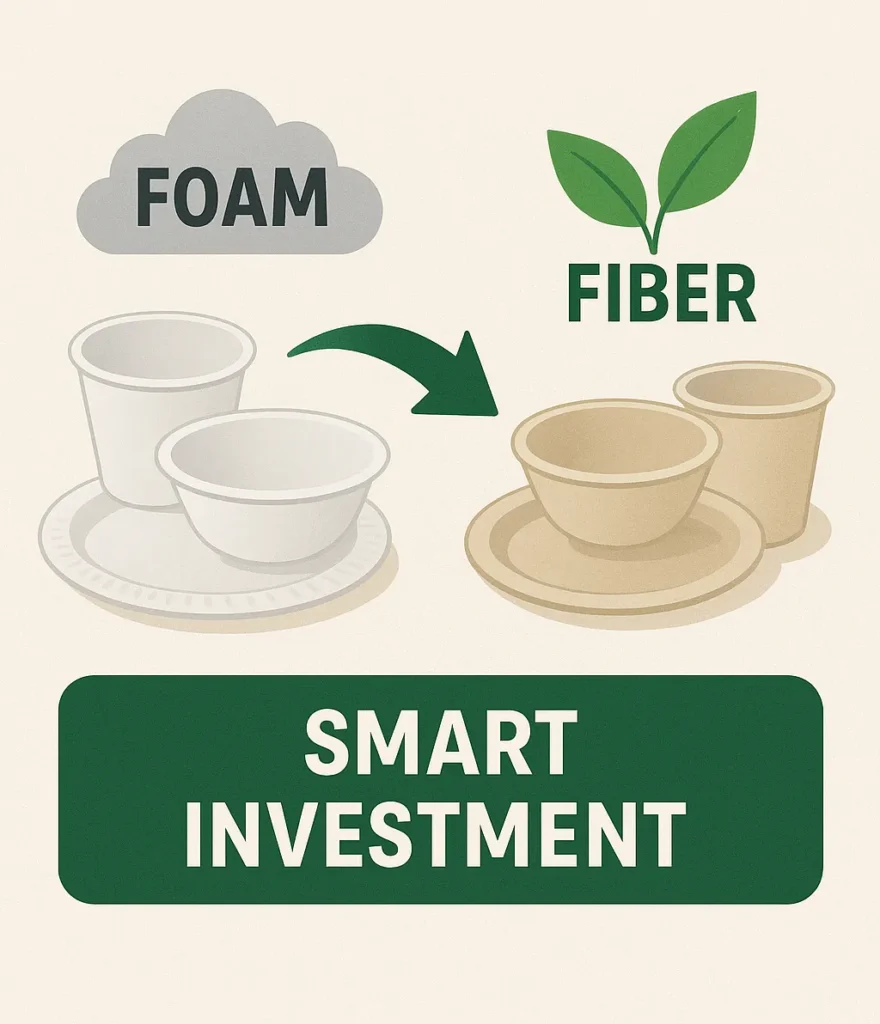
1. Made From Renewable, Plant-Based, and Recycled Resources
One of the strongest environmental advantages of molded fiber packaging is its material origin. Instead of relying on petroleum-based plastics, molded fiber uses:
- Recycled paper (waste newspapers, cardboard, office paper)
- Agricultural fibers such as bagasse, bamboo, wheat straw, and reed
- Forest by-products like wood pulp
This significantly reduces:
- Resource consumption
- Deforestation pressure
- Carbon footprint associated with virgin plastics
Pulp molding tableware machines—described in the main guide—are specifically engineered to process these fibers efficiently, turning low-value waste into high-value, fully functional packaging.
2. 100% Biodegradable and Compostable
Unlike plastic products that persist for hundreds of years, molded fiber packaging naturally breaks down within 60–120 days under composting conditions. Even in landfills, molded fiber decomposes far faster than polymers.
Environmental benefits include:
- Zero microplastic pollution
- No toxic residues
- Safe reintegration into natural ecosystems
This directly supports the circular economy model highlighted in the main guide, where molded fiber products return to the earth as organic matter, completing a closed-loop material cycle.
3. Low Energy Consumption and Reduced Emissions
Pulp molding tableware machines are designed to minimize environmental impact throughout the manufacturing process. Using energy-efficient drying systems, hot-press integration, and optimized pulp preparation, these machines help manufacturers achieve:
- Lower electricity usage
- Reduced CO₂ emissions
- Less water consumption and wastewater discharge
When compared to plastic production—which requires high temperatures, chemical polymerization, and fossil fuels—the environmental advantage of molded fiber is substantial.
Advanced systems such as HGHY’s integrated molding + hot-press lines further increase energy efficiency by combining forming and heat-setting in a streamlined, low-waste process.
4. Safe, Non-Toxic, and Food-Contact Compliant
Because molded fiber packaging uses plant-based materials and clean production processes, it contains:
- No BPA, phthalates, or petroleum derivatives
- No heavy metals
- No harmful chemical coatings when using eco-friendly formulas
This makes molded fiber a healthier choice for food service, takeout packaging, and disposable tableware. As explained in the main guide, pulp molding machines can also apply natural surface treatments to improve water and oil resistance without compromising sustainability.
5. Strong, Durable, and Lightweight—With Minimal Material Waste
Environmental sustainability is not only about biodegradability; it’s also about efficient resource usage. Molded fiber packaging offers:
- High structural strength
- Shock absorption
- Lightweight design
- Reduced material consumption compared to plastic alternatives
Modern thermoforming machines improve fiber distribution, wall thickness uniformity, and product density, ensuring strong performance while minimizing the raw materials used.
This efficiency supports the eco-focused priorities detailed in The Complete Guide to Pulp Molding Tableware Machines—showing how the right equipment maximizes both environmental performance and production profitability.
6. Supports Global Plastic Reduction Policies
Worldwide regulations are accelerating the shift away from single-use plastics. Molded fiber packaging aligns perfectly with policies such as:
- EU Single-Use Plastics Directive
- Canada’s plastic bans
- China’s phased plastic reduction roadmap
- The rising corporate ESG requirements
Manufacturers adopting molded fiber solutions gain a competitive advantage by offering products that meet compliance requirements across multiple countries.
Equipment described in the main guide—especially fully automated molded fiber tableware lines—makes it easy for businesses to upgrade production capacity while aligning with global sustainability agendas.
7. Enables Closed-Loop Recycling and Waste Valorization
Using waste paper and agricultural residues as raw materials transforms what would otherwise be landfill waste into commercially valuable packaging.
Environmental benefits include:
- Significant waste reduction
- Lower landfill pressure
- Recycling of by-products into new molded fiber items
- Full circularity when the packaging is composted after use
This aligns with the modern industrial trend where pulp molding machines support end-to-end eco-friendly production, from raw material recycling to finished product biodegradation.
Conclusion: Why Molded Fiber Is the Future of Eco-Packaging
The environmental advantages of molded fiber packaging are clear: renewable raw materials, biodegradability, low emissions, energy-efficient production, and global policy alignment. When paired with the innovations and complete production systems introduced in The Complete Guide to Pulp Molding Tableware Machines, molded fiber becomes not just an alternative—but the leading solution for sustainable packaging worldwide.