
In the modern eco-friendly packaging industry, bagasse pulp has become one of the most promising raw materials for producing biodegradable tableware. However, achieving stable quality and high strength in the final products largely depends on how well the bagasse pulp is processed and refined before molding. In this article, we’ll explore key strategies to improve the quality of bagasse pulp—ensuring smoother forming, stronger finished tableware, and better overall production efficiency.
This article is part of our in-depth series — read the main guide: The Complete Guide to Pulp Molding Tableware Machines.
1. Selecting High-Quality Raw Bagasse
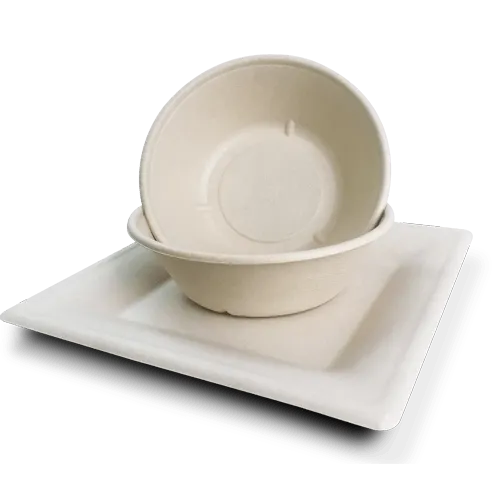
The foundation of good pulp lies in the quality of raw sugarcane residue. Always choose fresh, clean bagasse from sugar mills that follow proper handling and drying processes.
- Low impurity rate (<2%) ensures minimal fiber damage.
- Moderate fiber length (1–3 mm) improves pulp bonding.
- Avoid overly dried or moldy bagasse, as it weakens fiber integrity and increases bleaching demand.
By working directly with reliable sugar mills, manufacturers can ensure a consistent fiber composition, leading to better uniformity and forming performance.
2. Optimizing the Pulping Process
The pulping process determines fiber structure and cleanliness. Two main pulping methods are used:
- Chemical pulping (e.g., soda or kraft process): ideal for fine tableware with smooth surfaces.
- Mechanical pulping: suitable for lower-cost, thicker items like trays or bowls.
To enhance pulp quality:
- Control cooking temperature (150–170°C) and alkali concentration (10–14%) to avoid over-digestion.
- Use multi-stage washing to remove residual lignin and silica.
- Apply deinking and screening to improve color brightness and reduce particle contamination.
The goal is to achieve fibers with high bonding potential and minimal shives, ensuring a clean, even pulp suspension.
3. Refining and Beating Adjustment
Proper beating increases the fiber’s bonding area and flexibility, essential for forming dense, smooth tableware.
- Maintain Canadian Standard Freeness (CSF) between 300–450 ml for most molded fiber tableware.
- Avoid over-beating, which can shorten fibers and reduce drainage.
- Use disc refiners with precise pressure control to achieve stable pulp consistency.
Modern pulp molding lines often integrate automatic pulp refining systems, allowing real-time adjustment to match product requirements such as plates, cups, or lids.
4. Chemical Additives for Pulp Enhancement
To further improve quality and functionality, small amounts of additives can be used:
- Retention aids (e.g., cationic polymers) – improve fine fiber retention.
- Sizing agents – enhance water and oil resistance.
- Biodegradable strengthening agents – boost product rigidity without compromising compostability.
Maintaining eco-compliance is essential. All additives should be food-contact safe and 100% biodegradable to meet international sustainability standards such as FDA, EU 1935/2004, and ISO 17088.
5. Consistency Control and Mixing
A uniform pulp concentration ensures even molding thickness and consistent strength across products.
- Maintain pulp concentration between 0.8–1.2% for forming.
- Use agitators or high-shear mixers to prevent fiber sedimentation.
- Implement automated pulp consistency sensors to stabilize feeding performance.
Stable pulp consistency reduces defects like warping, weak spots, and uneven texture in the molded tableware.
6. Quality Testing and Monitoring
High-quality production requires continuous testing throughout the process:
- Fiber morphology analysis for length, coarseness, and fines content.
- Pulp brightness and pH control for color and stability.
- Lab-scale molding trials to evaluate forming behavior and drying shrinkage.
By establishing a reliable quality monitoring system, manufacturers can detect variations early and adjust pulping or refining parameters before large-scale production.
7. Integrating Technology and Automation
Modern pulp molding tableware machines—such as those developed by industry leaders like HGHY—now include automated systems that synchronize pulping, forming, and hot-pressing stages. This integrated design ensures:
- Precise temperature and pressure control.
- Real-time pulp flow monitoring.
- Consistent product surface smoothness and strength.
Such innovations dramatically enhance both production stability and final product quality.
Conclusion
Improving the quality of bagasse pulp is not just a technical task—it’s the foundation for achieving premium-grade biodegradable tableware that meets modern sustainability demands. From careful raw material selection to intelligent process automation, every step directly impacts the final outcome.